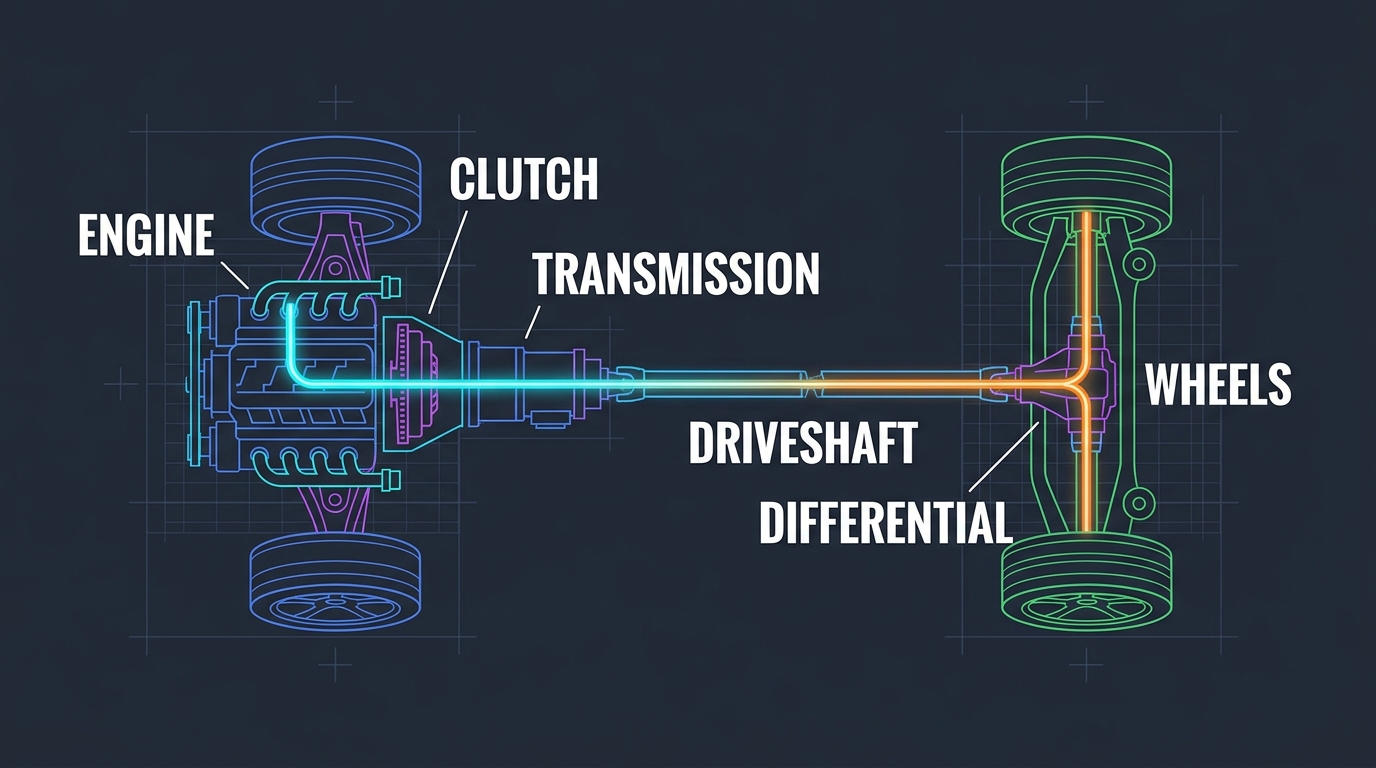
An engine has one strange limitation: it must keep spinning to stay alive. Your wheels, meanwhile, need to stop at red lights, creep through traffic, and rotate at different speeds through every corner. Bridging that gap is the job of the drivetrain — and it solves three distinct problems: disconnecting power, multiplying it, and splitting it.
The Disconnect: Clutches and Torque Converters
If the engine and wheels were welded together, stopping the car would instantly stall the engine. Every car needs a way to separate them.
In a manual car, that’s the clutch — friction discs pressed together by strong springs. Pressing the pedal pulls the discs apart, cleanly severing engine power from the wheels. And you can’t just drop the pedal instantly: the plates are designed to slip slightly as they come together, turning what would be a violent jerk into a smooth transfer of power.
Automatics use something cleverer: the torque converter. Imagine two desk fans facing each other — switch one on, and its airflow spins the unplugged one. A torque converter does exactly that, but with thick hydraulic fluid instead of air. The engine spins one impeller, the fluid spins the other, and at a stoplight the fluid simply slips — no stalling, no pedal.
The Multiplier: Why Gears Exist
Engines only make good power in a narrow band of RPM. The transmission exists to keep the engine in that sweet spot whether you’re crawling in a parking lot or cruising at highway speed.
The best analogy is a multi-speed bicycle. First gear is easy to pedal but slow; high gears are hard to start in but fast once you’re rolling. Low gears trade speed for torque multiplication — extra twisting force for pulling away — while high gears trade torque for speed and efficiency.
In a manual transmission, the shift lever physically moves metal forks that lock different gear pairs to the output shaft — raw, direct control. An automatic transmission does the same math for you, using hydraulic fluid channels and computer sensors to read your speed and pedal pressure and engage the right ratio without you lifting a finger.
The Splitter: The Differential
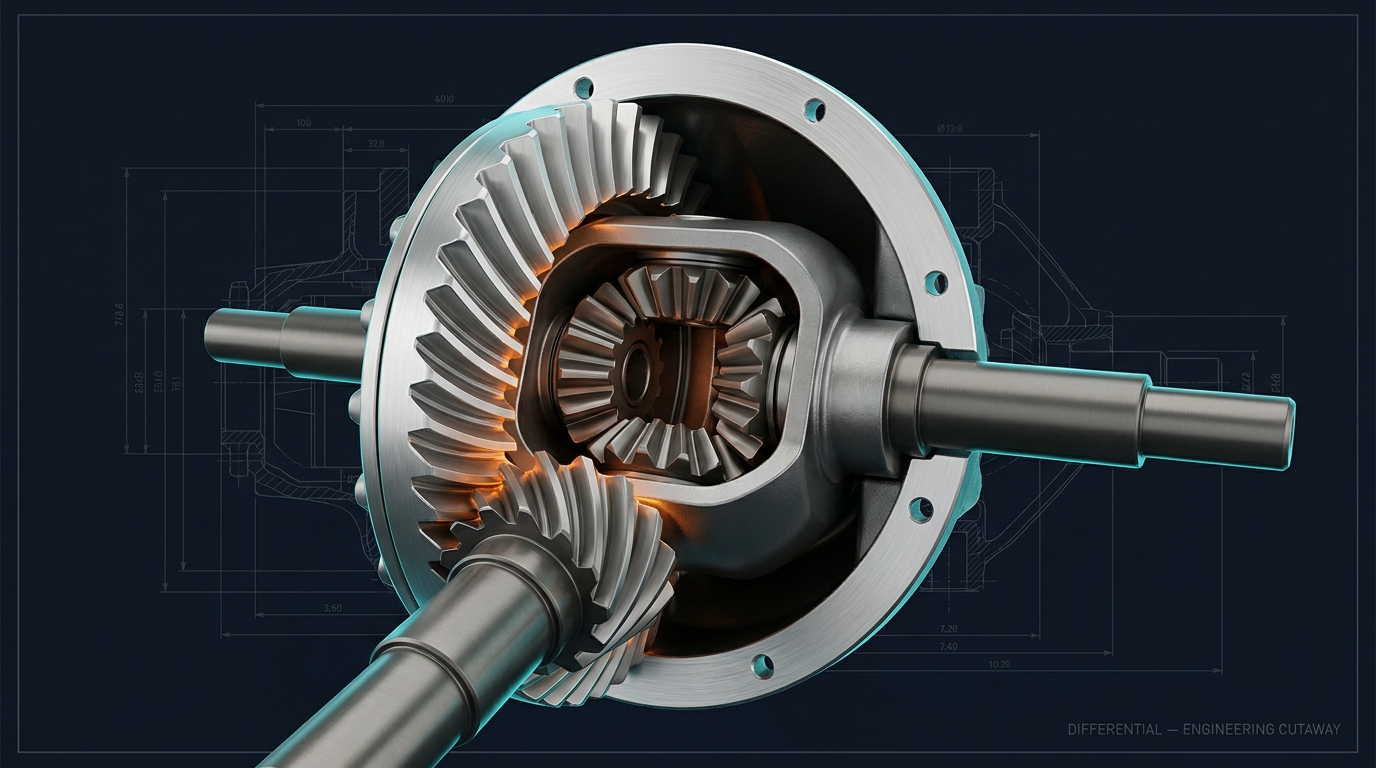
There’s one last problem, and it only appears in corners. When a car turns, the outside wheels travel a longer path than the inside wheels — so they must spin faster. If both drive wheels were bolted to one solid bar, one tire would drag, hop, and screech through every turn, destroying tires and stressing the axle.
The differential solves it. Sitting between the left and right drive wheels, it takes one spinning input from the transmission and splits it into two independent outputs. Inside, a clever arrangement of small spider gears lets the outside wheel speed up while the inside wheel slows down — all while both keep receiving power. The result is seamless, hop-free cornering so natural you’ve probably never noticed the problem existed.
Disconnect, multiply, split: three jobs, three brilliant mechanisms. Once you understand them, a lot of driving sensations suddenly have names — the bite point of a clutch, the downshift before a hill, the effortless way a car sweeps through a corner. The drivetrain is invisible from the driver’s seat, and that’s exactly the point.