Burning fuel turns a huge share of its energy into raw heat rather than motion. Left unchecked, that heat would warp metal and seize the engine solid within minutes. Yet a cold engine is bad too — it burns fuel inefficiently and wears faster. The cooling system’s real job isn’t making the engine cold. It’s holding it in a narrow Goldilocks zone, roughly 195 to 220 degrees Fahrenheit.
The Coolant Loop
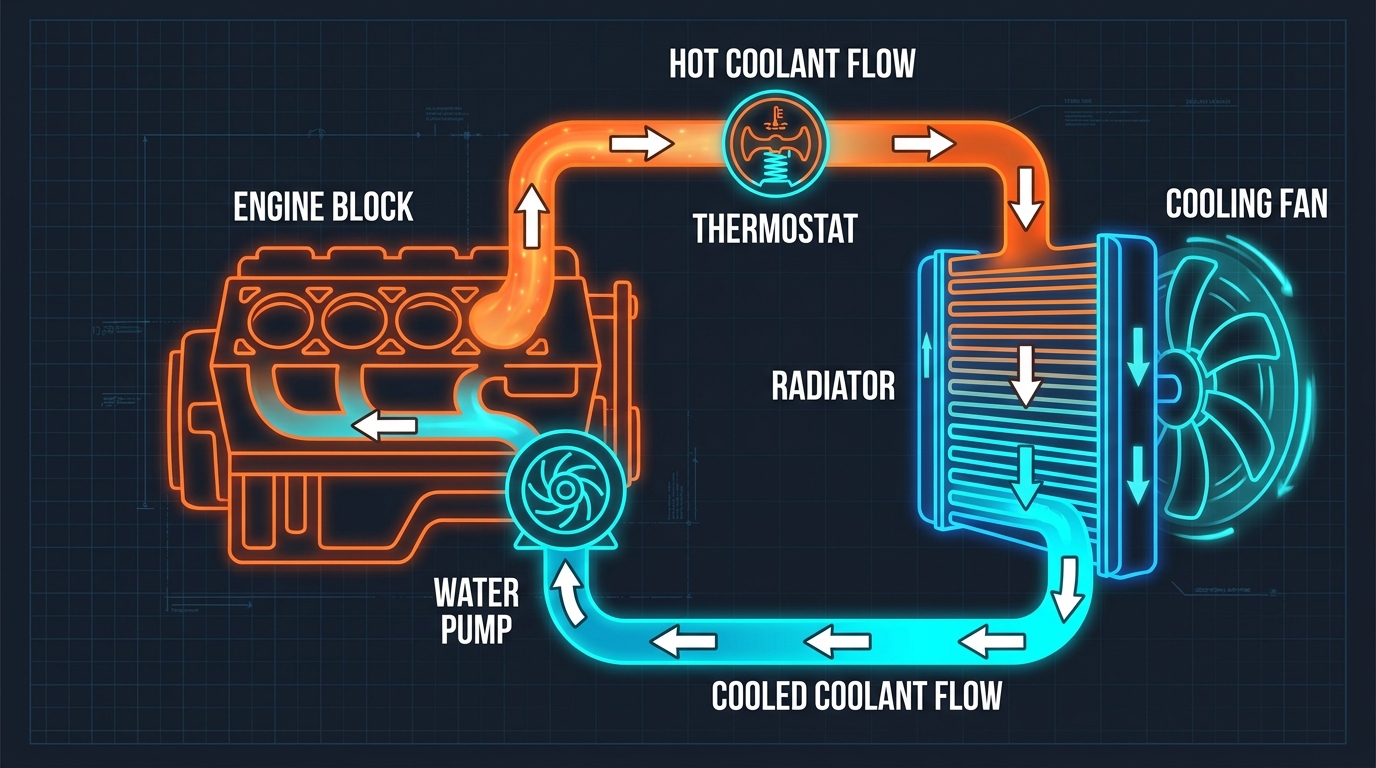
The heart of the system is a liquid circuit. Coolant — a blend of water and ethylene glycol antifreeze — flows through hidden passages cast right around the hot cylinders, soaking up their heat. The glycol raises the boiling point so it won’t boil over in summer and lowers the freezing point so it won’t turn to ice in winter.
Coolant can’t circulate on its own. The water pump, usually spun by a belt off the engine, uses a fan-like impeller to push it around the loop continuously. If the pump fails, flow stops and the engine overheats within minutes.
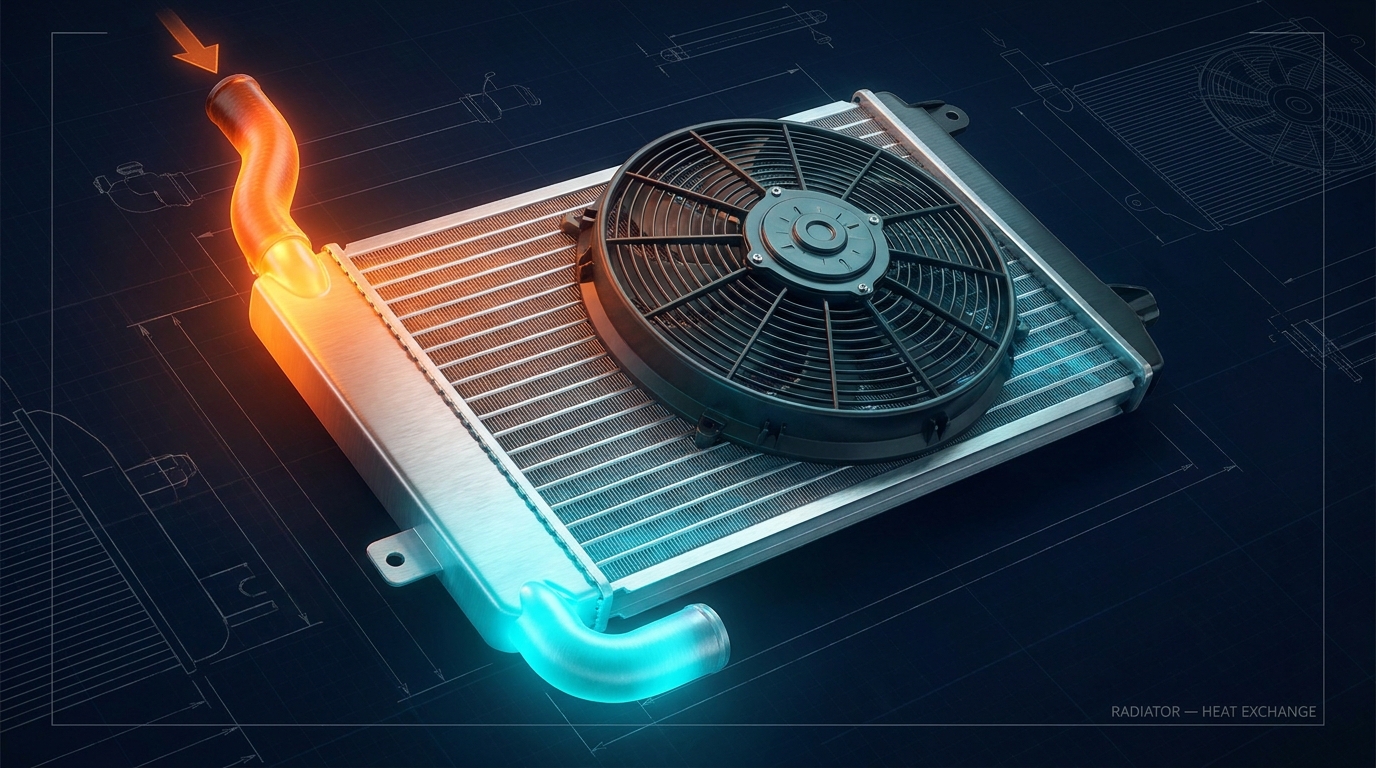
The heat finally escapes at the radiator: a maze of thin, finned tubes at the front of the car. Air rushing past the fins strips the heat into the atmosphere, and the cooled liquid loops back to do it all again.
Regulating the Temperature
Holding that narrow temperature window takes some clever hardware. The thermostat is an automatic gatekeeper between the engine and radiator. When the engine is cold it stays shut, trapping coolant in the block so the engine warms up quickly. Inside is a wax pellet that melts at around 195°F, expanding to open the valve and finally let coolant reach the radiator.
On the highway, air naturally blasts through the radiator — but stuck in traffic there’s no airflow at all. That’s when the electric cooling fan switches on, pulling air through on demand (it also runs whenever you use the air conditioning).
Your window into all of this is the dashboard temperature gauge, which reads the coolant temperature. It should settle near the middle once warmed up; a needle climbing toward the red is your early warning to pull over before the engine cooks itself.
Climate Control: Borrowing and Moving Heat
Here’s an elegant bonus: your cabin heater is nearly free. A small radiator called the heater core taps into the hot engine coolant, and a fan blows that existing warmth into the cabin — heat that was headed out the radiator anyway.
Air conditioning is the reverse trick: moving heat out of the cabin using a refrigerant. The engine-driven A/C compressor squeezes refrigerant gas, raising its pressure and temperature; the condenser at the front of the car dumps that heat outside; then the refrigerant expands and turns icy cold inside the evaporator, where a fan blows cabin air across it and chilled air pours from your vents.
The A/C has a hidden talent, too: cooling the air condenses moisture out of it. Dry air can’t hold fog — which is why switching on the A/C clears a foggy windshield almost instantly, even in winter.
Cooling is a system you only notice when it fails — which is exactly what makes it worth understanding. A temperature needle, a wisp of steam, a sweet smell from the vents: each one now points you to a specific part of one continuous loop of borrowed and discarded heat.