Every time you turn your key or press a start button, thousands of tiny controlled explosions begin firing inside your engine — over and over, thousands of times per minute. That process is the four-stroke combustion cycle, and understanding it is the foundation of all automotive knowledge.
The Four-Stroke Combustion Cycle
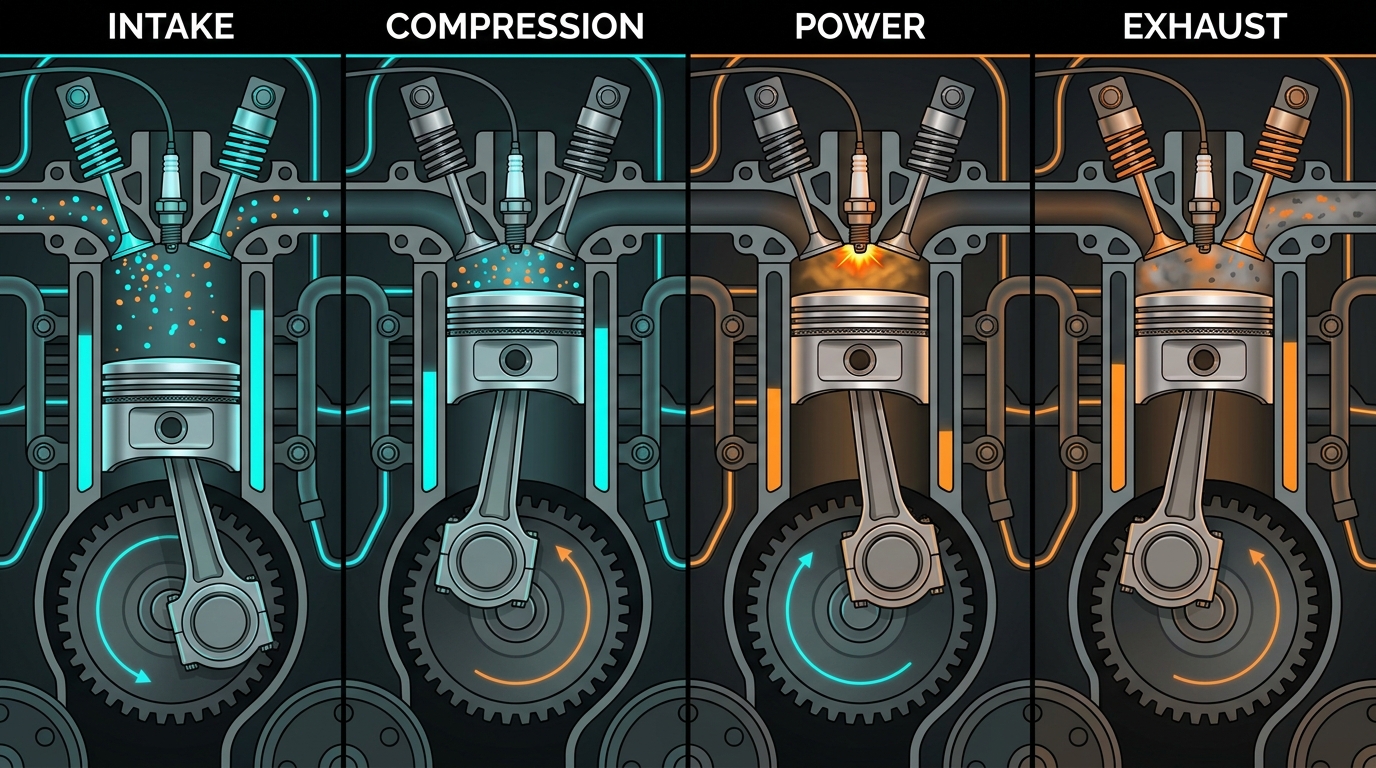
A modern internal combustion engine completes four strokes in every cycle: Intake, Compression, Power, and Exhaust — nicknamed “Suck, Squeeze, Bang, Blow.”
Intake stroke — The piston moves down and pulls a mixture of air and fuel into the cylinder through an open intake valve. Think of it as the engine taking a breath.
Compression stroke — The intake valve closes and the piston moves back up, compressing the air-fuel mixture to a fraction of its original volume. Compressing it makes the upcoming explosion far more powerful.
Power stroke — The spark plug ignites the compressed mixture, creating a small controlled explosion that forces the piston down with tremendous force. This is the only stroke that generates power — the other three exist purely to make it possible.
Exhaust stroke — The exhaust valve opens and the piston moves back up, pushing the burnt gases out of the cylinder and clearing it for the next cycle.
This entire four-stroke cycle repeats approximately 3,000 times per minute at highway cruising speed — and even faster during hard acceleration.
Pistons, Connecting Rods, and the Crankshaft
The cycle above describes what happens chemically inside the cylinder. But how does that explosion translate into your car actually moving?
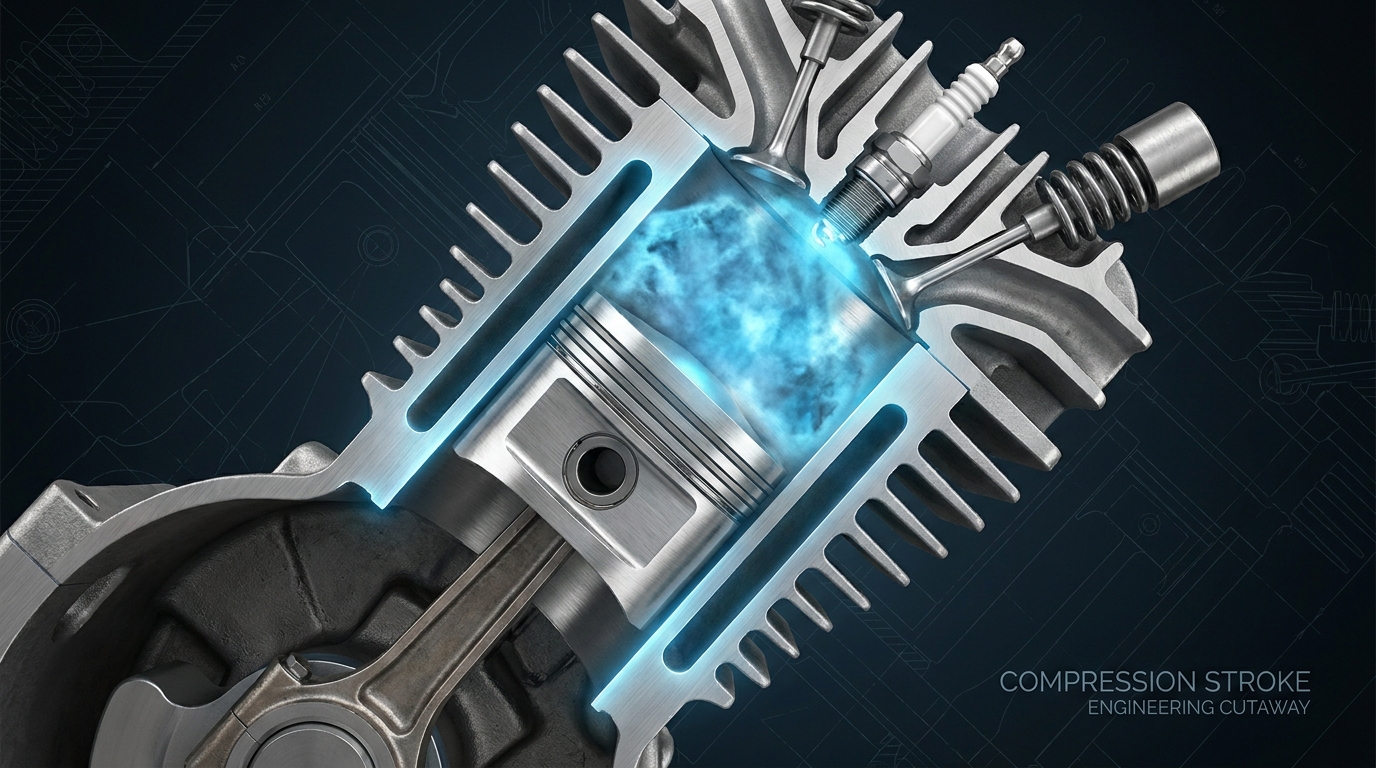
The piston is a metal cylinder that slides up and down inside the engine block, absorbing the force of each combustion event. It forms a near-perfect seal with the cylinder walls using metal rings, ensuring the explosion’s force pushes the piston down rather than leaking past it.
The connecting rod links the bottom of the piston to the crankshaft, transferring the up-and-down motion. It acts as the mechanical bridge between linear piston motion and rotational motion.
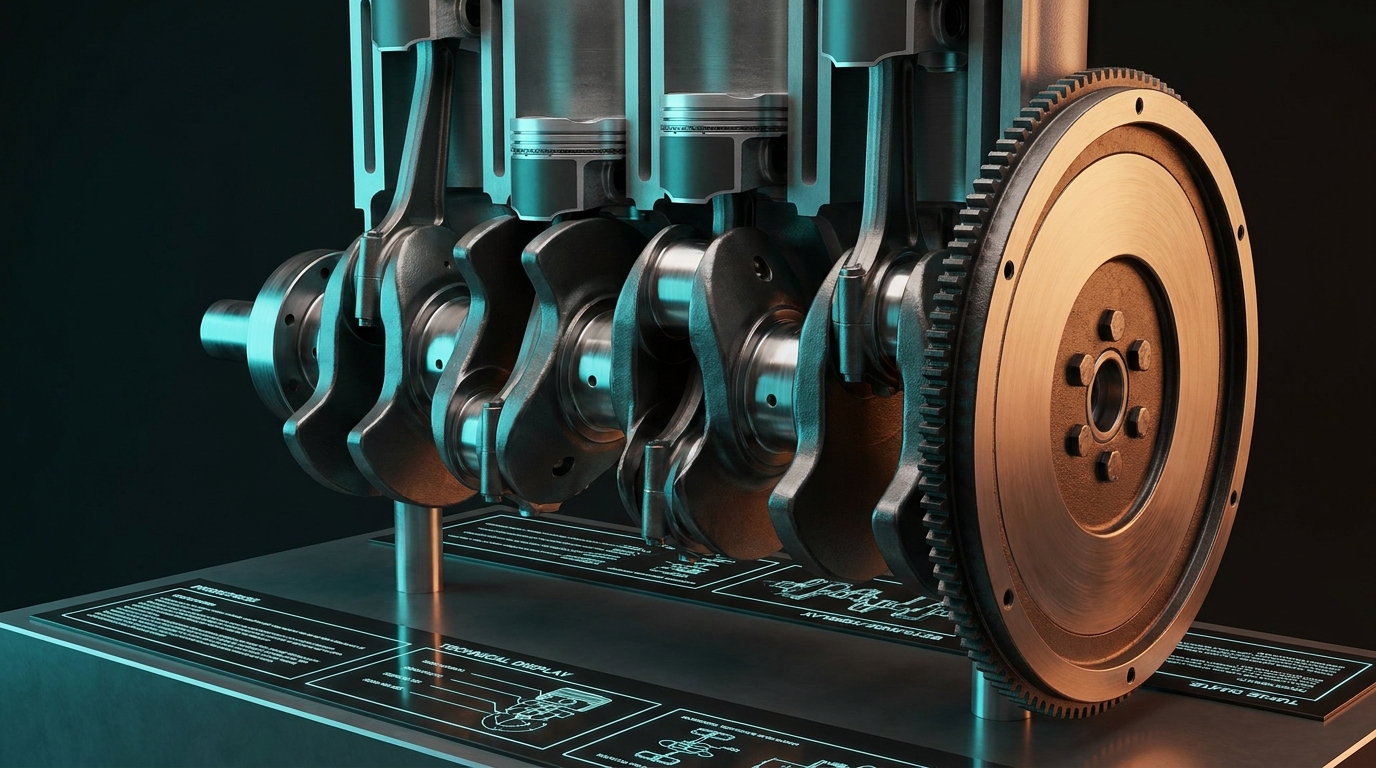
The crankshaft converts that up-and-down piston motion into rotation — the spinning force that eventually reaches your wheels via the transmission and driveshaft. It’s one of the most elegantly engineered parts in a car: a series of offset journals that turn a push into a spin.
The flywheel, attached to the end of the crankshaft, uses its mass and momentum to keep the crankshaft spinning smoothly between power strokes. Without it, the engine would feel jerky and uneven, since only one stroke in four actually generates power.
Understanding these fundamentals unlocks everything else in automotive mechanics — from why engine displacement matters, to how turbochargers work, to what makes a high-revving sports car engine feel so different from a torque-heavy truck engine. It all starts here.