Strip away everything you’ve learned about combustion — pistons, valves, spark plugs, exhaust — and a car can still move. An electric car replaces thousands of controlled explosions per minute with something almost eerily simple: magnets, arranged cleverly.
The Electric Motor: Magnets in Motion
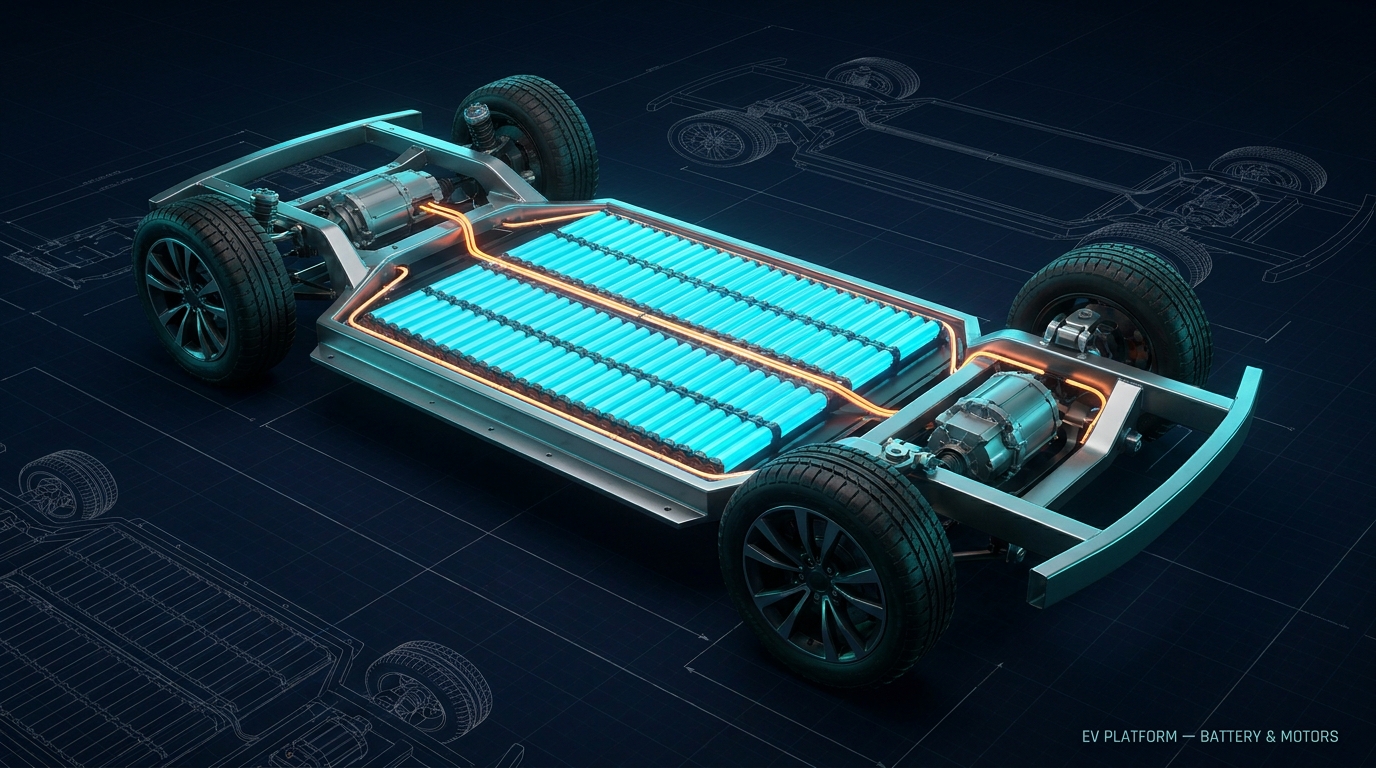
An electric motor has no explosions and no reciprocating parts. A fixed ring of electromagnets surrounds a spinning rotor, and by rapidly flipping magnetic poles in sequence, the motor makes those magnets attract and repel in a precisely timed rhythm — spinning the rotor with nothing but magnetism.
That design gives EVs their signature party trick: instant torque. A gas engine has to rev up before it makes real pulling power; an electric motor delivers its full twisting force from zero RPM, the instant it starts turning. It’s why even modest electric cars feel so quick and silent off the line.
Two supporting players make it work. The inverter converts the battery’s direct current into the alternating current the motor needs, and by changing how fast it switches, it precisely controls the motor’s speed and power — it’s the real throttle of an EV. And because the motor pulls strongly across a massive speed range, there’s no multi-speed gearbox at all: most EVs use a single fixed reduction gear. No shifting, ever.
The Battery Pack: Thousands of Cells, One Brain
An EV isn’t powered by one giant battery, but by hundreds or thousands of small lithium-ion cells wired together — bundled into modules, combined into one large pack, usually laid flat under the floor (which is also why EVs corner so flat: all that weight sits low).
Capacity is measured in kilowatt-hours (kWh) — simply how much energy the pack holds, exactly like the size of a fuel tank. More kWh, more range.
With that many cells, something has to keep order. The Battery Management System (BMS) watches the voltage and temperature of the cells, keeps them balanced, and guards against overcharging and overheating. Many packs are also wrapped in liquid heating and cooling channels, because lithium cells perform and age badly outside their comfort zone — good thermal control means longer battery life and faster, safer charging.
Braking That Recharges — and Blending in Gasoline
Normal brakes throw away a car’s motion as waste heat. An EV does something smarter: it runs its motor backwards as a generator, so the car’s momentum generates electricity that flows back into the battery while slowing the car. This regenerative braking is often strong enough for one-pedal driving — lift off the accelerator and the car slows noticeably, no brake pedal needed. (Friction brakes remain for hard stops; regen fades at very low speed and can’t deliver an emergency stop alone. And on a long downhill, an EV genuinely harvests the descent — you can arrive at the bottom with more range than you started.)
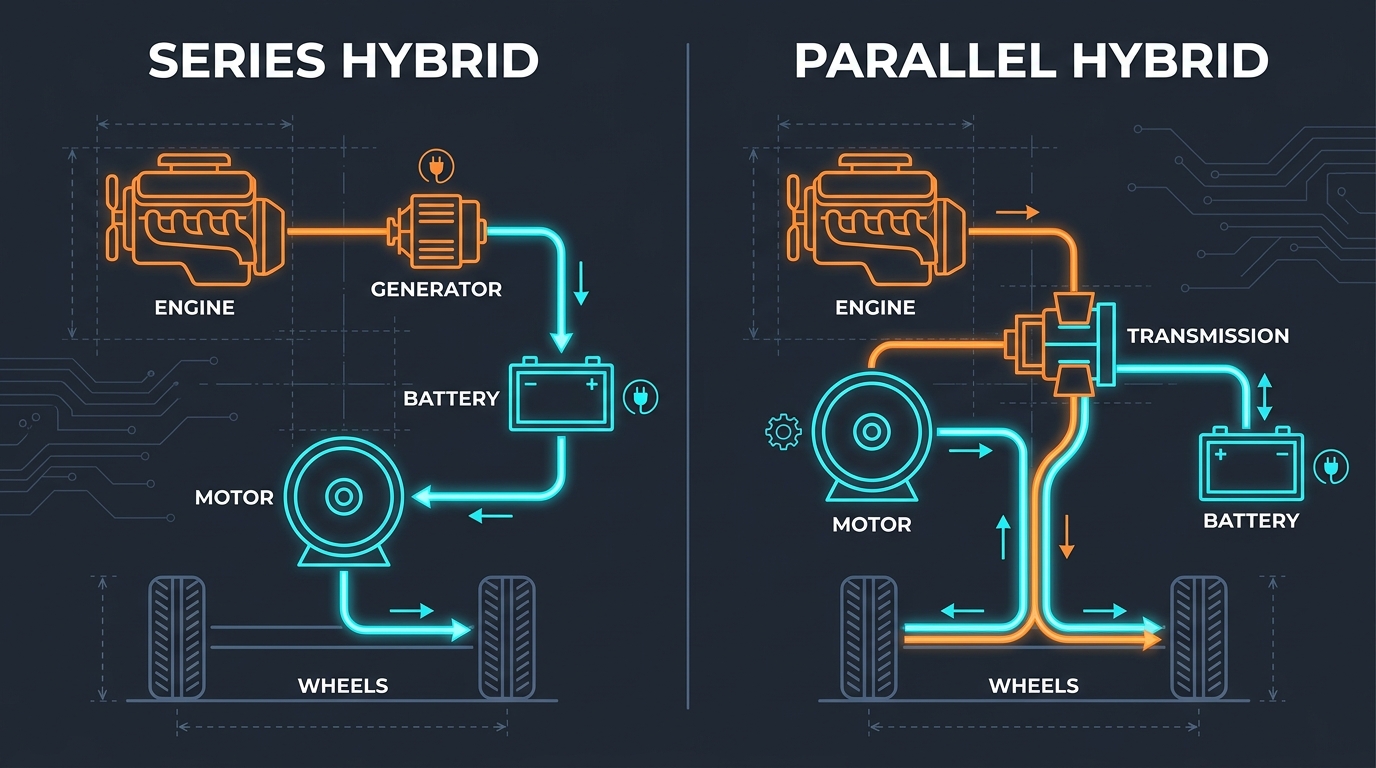
Hybrids blend both worlds: a small gas engine, an electric motor, and a modest battery. In a series hybrid, the engine never drives the wheels — it only spins a generator, acting as a quiet onboard power plant while the motor does the driving. In a parallel hybrid, both can turn the wheels, teaming up for acceleration or letting the car glide on electricity at low speeds. Hybrids sip fuel by attacking waste from every angle: the engine shuts off at stops, the motor handles inefficient city crawling, and regen recaptures energy that would otherwise be lost.
Electric drive isn’t just a different fuel — it’s a fundamentally simpler machine layered with clever control. Fewer moving parts, instant response, and energy that flows both ways. Understand motors, packs, and regen, and you understand where the entire car industry is heading.