The four-stroke cycle gives an engine its rhythm, but two supporting systems decide whether it runs at all. One delivers a precisely timed bolt of artificial lightning to start every power stroke. The other keeps hundreds of fast-moving metal parts from grinding themselves to death. Lose either one, and even a perfect engine dies in minutes.
The Ignition System: Lightning on Demand
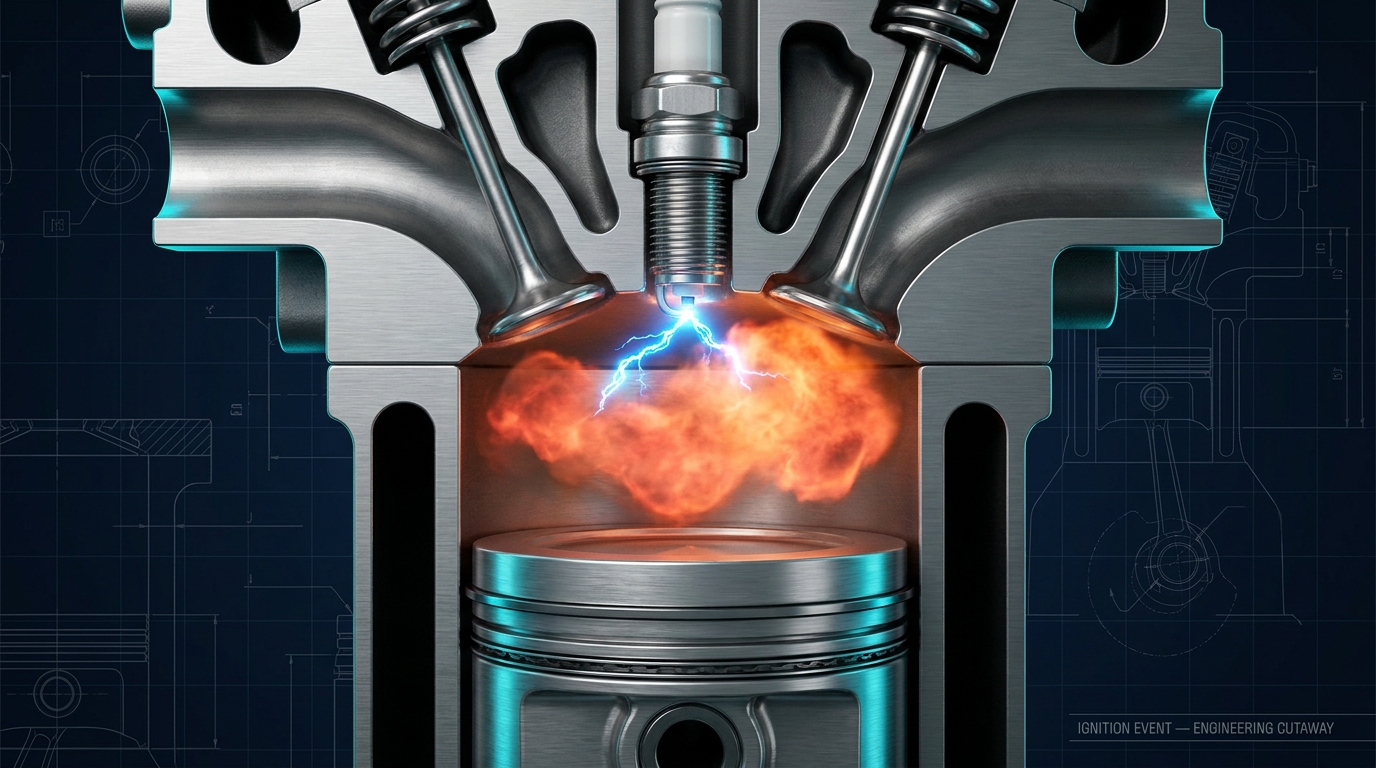
Compressed air and fuel won’t ignite on their own in a gasoline engine — they need a trigger. That trigger is the spark plug, which sits at the top of each cylinder and jumps a small electrical arc across its gap at exactly the right moment.
There’s a problem, though: your car’s battery only supplies 12 volts, nowhere near enough to punch a spark through a dense, highly compressed mixture. That’s the job of the ignition coil. Acting as a transformer, it steps 12 volts up to 30,000 volts or more — a massive voltage spike strong enough to arc across the plug gap and start the fire.
Just as important as the spark itself is when it happens. Engine timing is the precise synchronization of the spark with the piston’s position. The plug actually fires slightly before the piston reaches the top of the compression stroke, giving the flame time to spread so that peak pressure arrives at exactly the right moment. Timing that’s off in either direction costs power — and can physically damage the engine.
When a cylinder fails to fire properly, you get a misfire. A worn spark plug, a weak coil, or a wrong air-fuel ratio are the usual culprits. A misfiring engine feels rough, sounds strange, and loses noticeable power — it’s one of the most common check-engine causes on older cars.
The Lubrication System: The Engine’s Lifeblood
An engine is packed with metal parts sliding and spinning against each other thousands of times per minute. Without lubrication, friction would generate enough heat to literally weld those parts together. Motor oil prevents that by forming a slippery, microscopic film that keeps metal surfaces from ever truly touching.
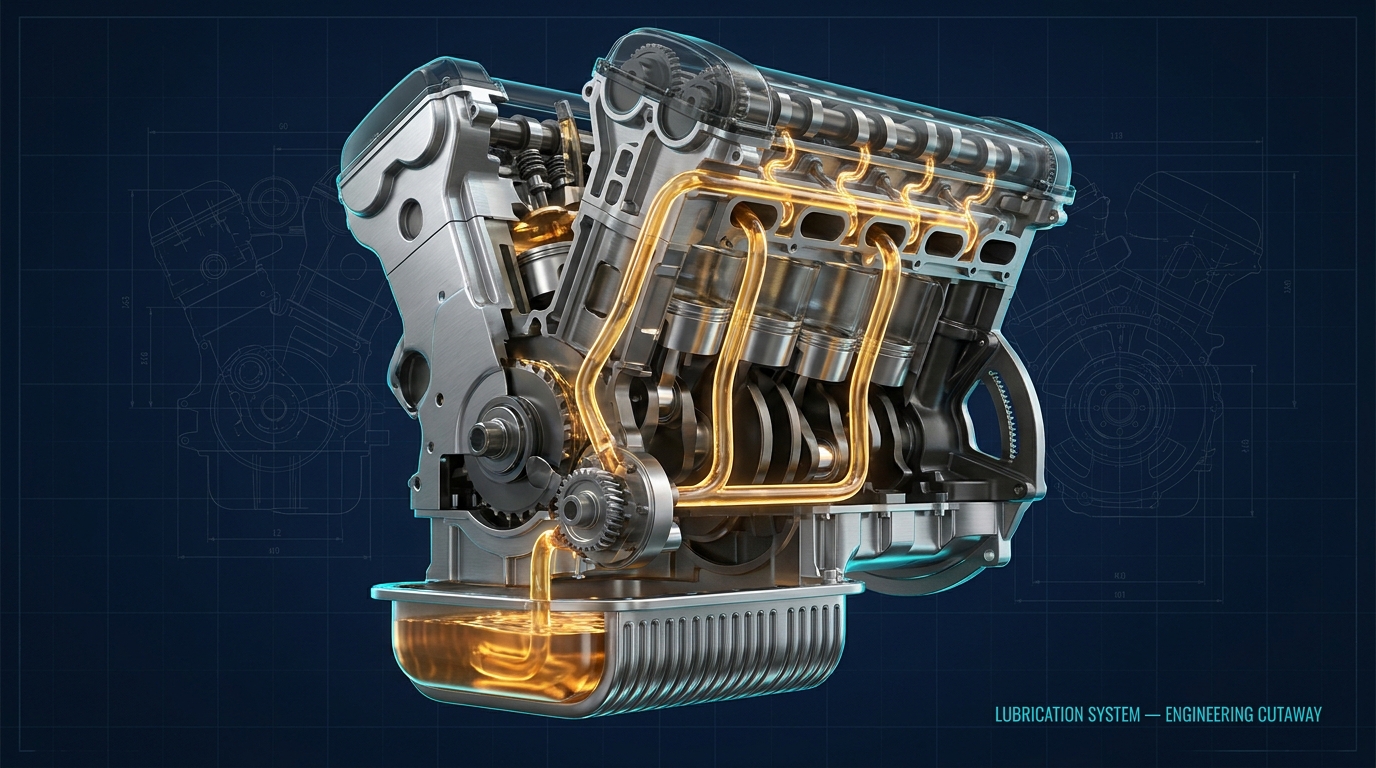
The oil pump is the heart of the system. It sits at the bottom of the engine, drawing oil from a reservoir called the oil pan, pressurizing it, and forcing it through internal passages to every bearing, journal, and moving joint in the engine block.
The oil filter keeps that oil clean. As parts wear, microscopic metal shavings break off into the oil stream. The filter’s paper element traps this debris permanently while letting clean oil flow through — which is why it gets replaced with every oil change.
Then there’s viscosity — simply an engineering term for how thick a fluid is. An engine needs oil thin enough to flow instantly on a freezing morning, yet thick enough to protect parts at full operating temperature. That’s what a rating like 5W-30 means: the number before the W describes cold-weather flow, and the number after describes thickness when hot.
Spark and oil are a perfect illustration of how a car really works: the dramatic part — combustion — only happens because quieter systems do their jobs perfectly, thousands of times a minute. Next time an engine starts on the first crank and idles smoothly, you’ll know exactly which two systems deserve the credit.