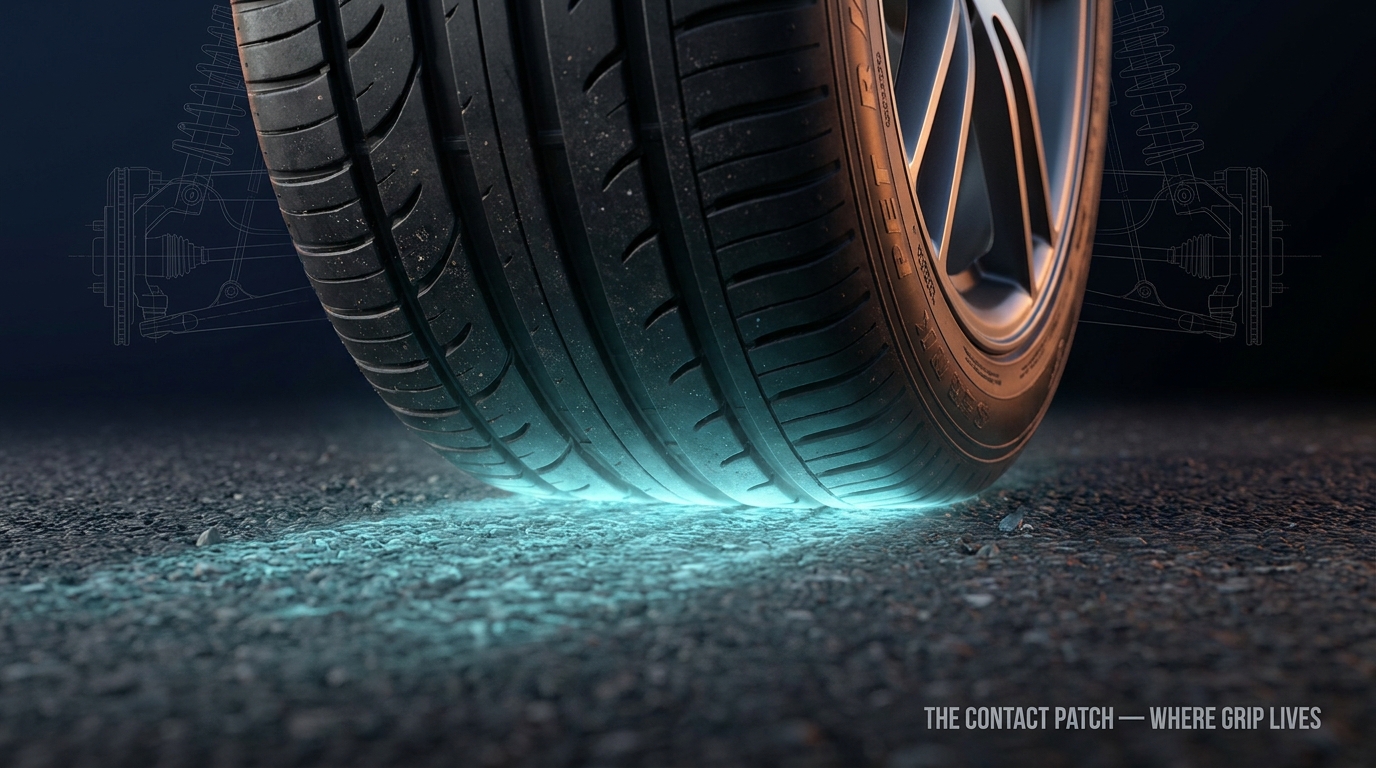
No matter how powerful or expensive a car is, it touches the road through just four contact patches, each about the size of your palm. Every launch, every corner, every emergency stop happens through those four patches of rubber. They are the most important real estate on the car.
How Rubber Actually Grips
Tire grip is more than simple friction. Soft, warm rubber actually flows into the microscopic peaks and valleys of the road surface and briefly bonds to it — a little like a gecko’s foot, gripping texture you can’t even see. This is why tire temperature and compound matter so much: warmer, softer rubber keys into the road better.
Here’s a myth worth busting: a wider tire doesn’t grip because it puts “more rubber on the road.” The contact patch area is set by the car’s weight and tire pressure — widen the tire and the patch mainly changes shape, from long and narrow to short and wide. That broader shape is what better resists the twisting loads of hard cornering.
Tread is a compromise with weather. On a bone-dry track, a smooth slick grips best because every bit of rubber touches pavement. But on a wet road, a slick would float on a film of water. Tread grooves are drainage channels that pump water out from under the patch — your defense against hydroplaning.
Drive Layouts: Which Wheels Get the Power?
The engine’s power has to reach the ground somewhere, and the choice shapes the car’s entire character.
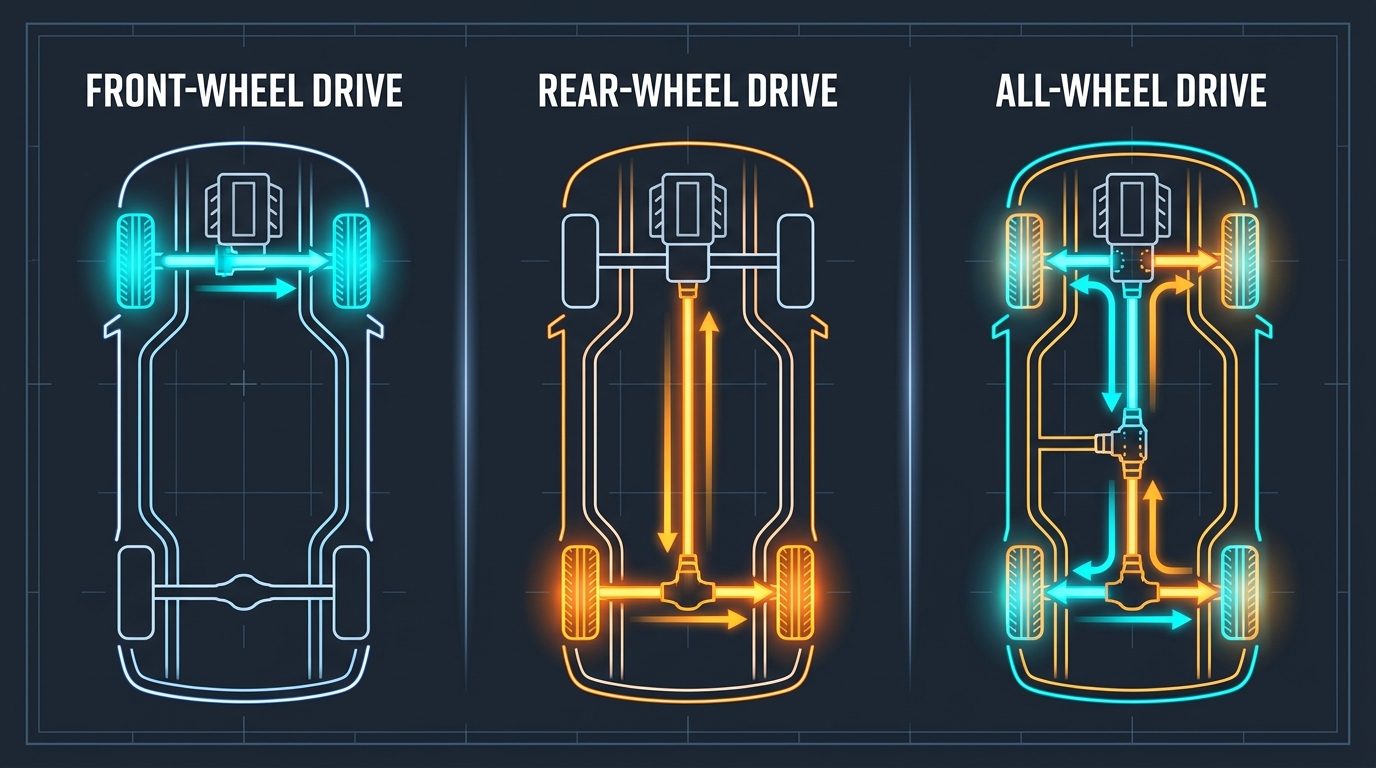
Front-wheel drive pulls the car from the front. It’s cheap to build, frees up cabin space, and puts the engine’s weight over the driven wheels — which is why most everyday cars use it, and why FWD cars do surprisingly well in snow.
Rear-wheel drive splits the jobs: front tires steer, rear tires push. That division balances the car and unlocks sharper handling, which is why sports cars and trucks favor it — at the cost of traction on slippery surfaces.
All-wheel drive sends power to all four patches at once. Spreading torque across four tires instead of two uses more of the available grip, giving confident acceleration on wet, snowy, or loose surfaces.
The Electronic Safety Net
When grip runs out, electronics step in — and they all build on the same wheel-speed sensors.
ABS (anti-lock braking) attacks panic stops. A locked wheel skids helplessly and can’t steer, so ABS senses a wheel about to lock and pulses the brake pressure many times a second to keep it rolling — a rolling wheel can still grip and steer around danger.
Traction control is the mirror image: it manages grip while accelerating. If a driven wheel spins uselessly on a slick launch, the system cuts engine power or brakes that one wheel until it bites again.
Stability control (ESC) is the ultimate net. A yaw sensor feels the car beginning to rotate the wrong way — the start of a slide — and the system brakes individual wheels to pull the nose back onto your intended path, catching understeer and oversteer faster than any human could react. All of it stays invisible until the moment you need it.
Grip is the true currency of driving: engines write checks, but the contact patches cash them. Once you think in terms of four palm-sized patches — how rubber holds, which wheels are driven, and what the electronics do when grip runs out — braking distances, snow behavior, and spec-sheet debates all start making real sense.