Burning more fuel makes more power — but fuel is useless without oxygen to burn it. A regular engine can only inhale whatever air the atmosphere pushes into it, like a sprinter breathing through a straw. Air, not fuel, is the real bottleneck on power. Forced induction removes that bottleneck with a pump that squeezes extra air into the engine, and boost is simply how far above normal atmospheric pressure that air is. Cram twice the air molecules into a cylinder and you can burn nearly twice the fuel — every bang gets dramatically stronger.
Turbochargers: Free Energy From the Exhaust
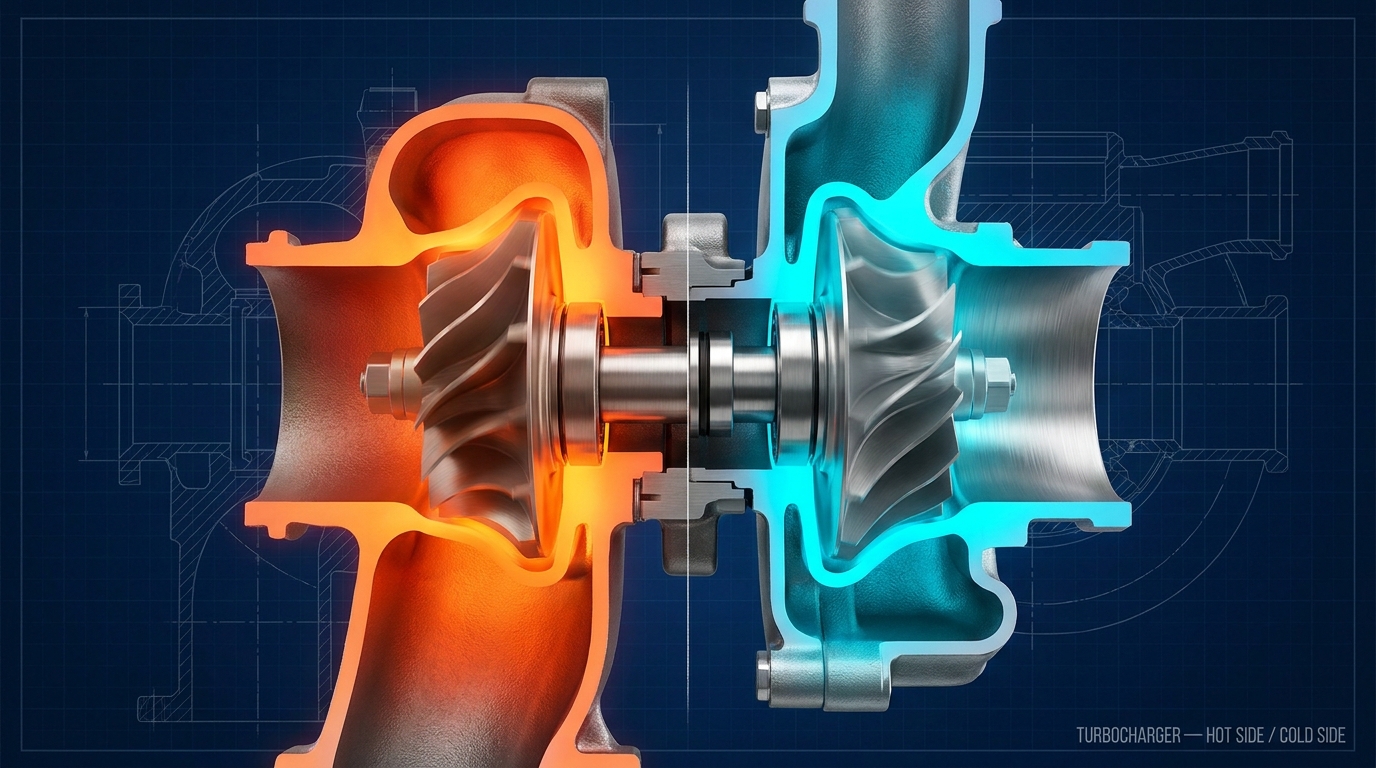
Every time a cylinder fires, hot exhaust gas rushes out carrying energy your engine paid for but never used. A turbocharger parks a small turbine wheel in that stream — like a windmill in a hurricane. The escaping gas spins it furiously, harvesting energy that was literally going out the tailpipe.
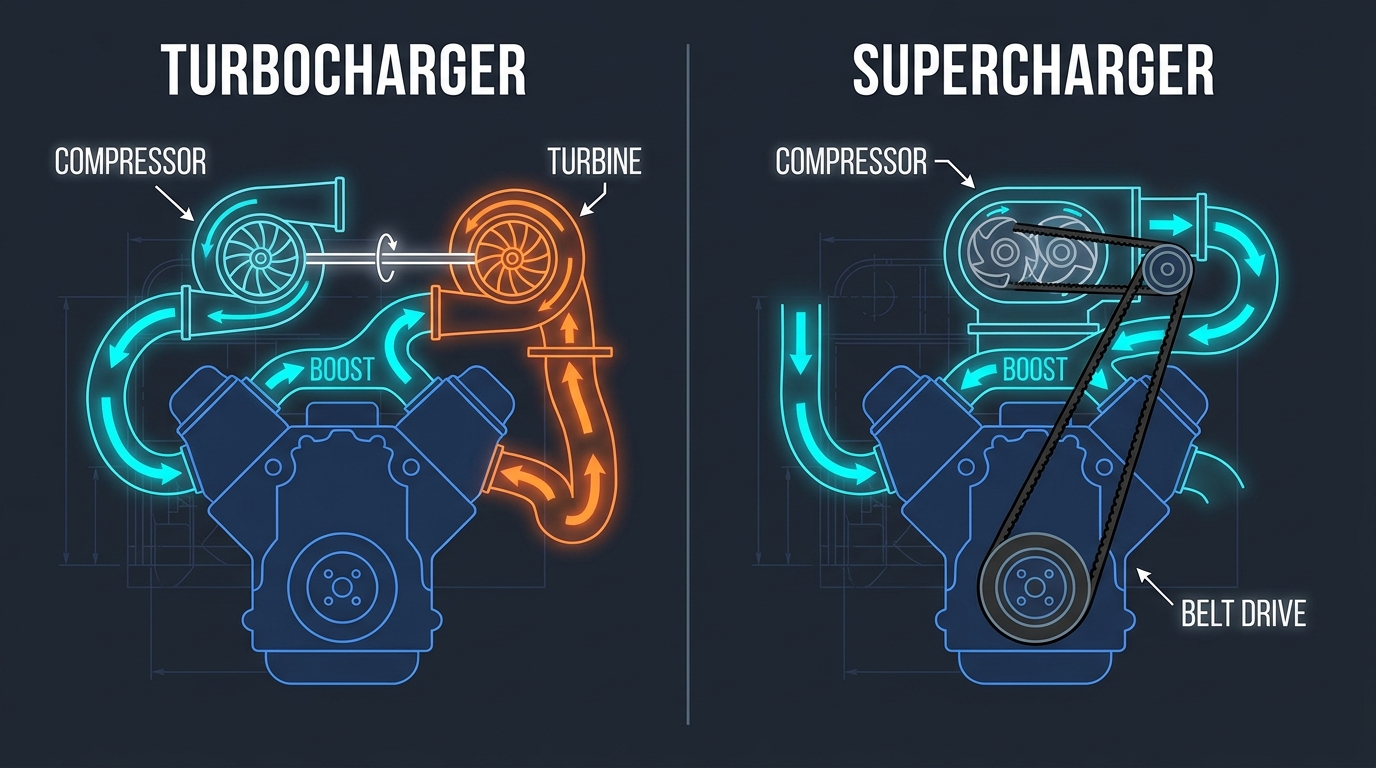
Inside, that turbine connects through a short shaft to a compressor wheel on the other side. As exhaust spins one, the other slurps in fresh air and squeezes it into the engine. The pair can spin at over 200,000 RPM — more than twenty times faster than the engine itself.
The catch is turbo lag. The turbine needs a strong flow of exhaust to spin up, and building that flow takes a moment — like pushing a heavy merry-go-round from a standstill. That pause between asking for boost and receiving it is the turbo’s defining quirk. Engineers fight it with tricks like the twin-scroll turbo, which gives alternating cylinders separate channels into the turbine so each exhaust pulse arrives clean and strong, spooling the turbo quicker.
Superchargers: Instant Boost, at a Price
A supercharger skips the exhaust entirely and bolts its air pump straight to the engine with a belt. Whenever the crankshaft turns, the supercharger turns with it — so boost arrives the instant you touch the throttle. No lag, just immediate shove.
They come in flavors: Roots and twin-screw types shove a fixed gulp of air with every revolution, delivering strong boost even at low RPM, while centrifugal types act like the compressor half of a turbo, building boost as engine speed climbs.
The trade-off is fundamental: spinning a supercharger takes real muscle, drawn from the very engine it’s helping — sometimes dozens of horsepower at full boost. It’s like hiring a brilliant assistant who takes a cut of your paycheck. That’s why automakers mostly choose turbos for efficiency, while hot rodders often choose superchargers for response and drama.
Keeping Boost in Check
Compressing air heats it, and hot air is weak air — fewer oxygen molecules per gulp, plus a higher risk of the mixture igniting on its own. A whole supporting cast exists to manage this.
The intercooler is a radiator for air: hot compressed charge flows through its tubes while outside air carries the heat away, delivering a cooler, denser, safer charge. The wastegate stops a turbo from feeding itself into a runaway spiral — when boost hits its target, the gate opens and lets exhaust bypass the turbine. The blow-off valve vents trapped pressure when you lift off the throttle, protecting the compressor — and producing the famous psshh that turbo fans adore.
And because boost squeezes the mixture harder and hotter, it invites knock — fuel exploding before the spark commands it. Boosted engines are built for the job, with tougher pistons, often gentler compression ratios, and frequently a demand for higher-octane fuel. Add big boost to a fragile engine, and it will not forgive you.
Forced induction is the art of getting something for almost nothing: a turbo recycles waste energy, a supercharger buys response with a slice of the engine’s own power. Either way, the lesson is the same one that governs all engines — power is made of air, and whoever moves the most air wins.